Apparently, I beat the excellent ad blog in Europe by one day on the New York Y & R story.
I guess that’s a bit of journalistic success.
Copywriting, branding and other mayhem.
April 18th, 2005 — Copywriting
Apparently, I beat the excellent ad blog in Europe by one day on the New York Y & R story.
I guess that’s a bit of journalistic success.
April 15th, 2005 — Copywriting
Ann Fudge, the 2-year-new CEO of Young & Rubicam, has been on a losing streak lately. She has been presiding over execs and clients abandoning ship.
Big billing losses include Burger King, Computer Associates International, Sony and Kraft Foods. The last loss really hurt as CEO Fudge had been a Kraft marketing hotshot before taking the helm at Y & R, and its parent company, Y & R Brands, which includes PR agency Burson-Marsteller, branding expert Landor Associates, and Wunderman, the well-known direct marketing agency.
Now comes word that Y & R has lost Jaguar, which bills $150 million globally to Euro RSCG Worldwide. Fudge neglected to attend the apparently key first meeting laying out the agency review, supposedly with the car maker’s consent.
Jaguar is owned by Ford which has three larger brands still handled by Y & R.
Staffing has been cut at the New York office alone by more than 10%, through both resignations and firing.
Fudge has admitted in a Business Week interview that she will relinquish the advertising hot seat at Y & R, while maintaining her top position at the parent company.
April 14th, 2005 — Uncategorized
The other day, one of the dedicated softball dads brought out one of the big guns, radar guns. He fired it at our pitcher and at the opposing team’s pitcher.
The pitches for both teams clocked in at 50 to 55 miles per hour. (Both pitchers seemed equally hittable: not very.)
I asked how does this compare to other girl’s pitching speeds. The umpire said he had just seen a freshman girl at another school who pitched fast — more than 60 miles per hour.
According to Slate, Jennie Finch pitches a softball at 70 miles per hour or more.
Somewhat surprisingly, for a baseball fan, a softball pitch is harder to hit than a baseball pitch. It comes down to physics, I guess and the differences between the two games.
In fact, in the 2004 Olympics, the ace American team allowed only one run in nine games. In softball, there are no great hitters, only great pitchers. The pitchers throw a bewildering variety of pitches from about 40 feet away.
In baseball, the pitcher stands back 20 more feet, and can throw a fastball at 90 miles per hour. Sure, the softball pitcher throws a slower ball. But the softball pitcher’s repertoire is far more challenging than a baseball pitcher’s. Whether it’s a rise ball, drop balls, or curve, they’re all tough to hit.
Recently, Jennie Finch has proven this by consistently striking out baseball hitters who’ve challenged her pitching abilities. But it’s not a new phenomenon: in 1967, a famous softball pitcher struck out Willie McCovey, Brooks Robinson, Willie Mays, Harmon Killebrew, and Roberto Clemente in an exhibition game.
Interestingly the underhand pitch was the rule in early 1900’s baseball. Back then — as in modern softball — the pitchers dominated the game. Nowadays, that underhand “softball style” pitch is illegal in baseball. And just maybe, the big-name baseball hitters are quite happy about that.
April 12th, 2005 — Copywriting
Frank H. Johnson died at the age of 88 on March 6, 2001.
He was a famous direct response copywriter with a distingushed career, including serving as the circulation and promotion manager for Fortune magazine for many years.
His most obvious claim to fame is that he invented box that bears his name, used in direct mail sales letters.
What is a Johnson Box? It is body copy that is emphasized by being in an outlined box composed of asterisks or a different background color than the body of the main text. It is a staple for creating any direct mail presentation. In effect, it is a super emphasized main point of the selling letter.
I found a few by searching the web. These examples include a photo of the product being sold and work as a call to action, closing the sale.
One direct mail agency president, Albert Fried-Cassorla, called Mr. Johnson’s invention “one of the most potent features of any direct mail communication.”
For more on Johnson boxes and other examples of effective direct mail methods, see Million Dollar Mailings by Denison , an unabridged-dictionary-sized book of the most effective mailings in recent years, and Overlines, Johnson boxes and other assorted screams and moans, a short e-document about direct response techniques.
April 11th, 2005 — Copywriting
Anheuser Busch, possibly in a marketing move meant to emulate the famous “New” Coke(tm) efforts of 1985, has introduced a new adult beverage, B-to-the-E. The new drink rolled out nationally in January this year, after successful marketing trials in New York, LA, Boston, Miami and other test markets.
This is a slim 10-ounce can that contains, in effect, the ingredients of that yummy rave drink Red Bull ™, and good ol’ Budweiser ™ beer. It contains caffeine, guarana and ginseng — a sort of healthy wake-up drink mixed with beer, 6.6 percent alcohol by volume. (I must have the turbo version. Web articles say it is a 4.5 percent alcohol beverage.)
Red Bull ™ has a healthful, uh, healthy, 70 to 90 per cent of the energy drink market — about $1.6 billion according to SellingPower.com. While describing this success, they admit it doesn’t taste very good: I’ve had it and it makes me long for orange Triaminic ™ Cough Syrup, which is flavored to prevent not-very-sick kids from malingering at home.
“You’ll need that orange cough syrup every four hours.”
“That’s OK, Mom. My throat feels better. I think I’ll go to school and take that test I haven’t studied for.”
I can see why anyone might try RB once, but repeat buying is a mystery. (There is no nicotine in any of these products.) Apparently, RB supports extreme sporting events and has a lot of word-of-mouth buzz marketing. Think young; think Tony Hawke fans. RB is often served as a mixer with vodka. (Aha, you gotta cut that candy sweetness with something.)
Anyway, Anheuser Busch ™ and Coca-Cola ™ have tried to enter this market for years to break the Bull’s dominance.
Apparently, B-to-the-E is the latest AB attempt. The sweetness of the product makes me think it is aimed at those younger drinkers whose number of years being of drinking age can be measuresd with a calendar or maybe a stopwatch.
The editor of All About Beer magazine says “You get a little bit drunk but it keeps you alert. ” Basically, she thinks this is as dumb an idea as I do. Rather than paraphrasing it read her beer marketing insights for yourself. Or see the allaboutbeer beer expert’s website.
The large grocery store where I bought B-to-the-E had NO six-packs for sale, only single cans. Do they know something about the product that a potential customer would want to know?
Grudgingly, I have tasted the new brew. It is supposed to have a berry, not beery, taste. Good news: it looks exactly like Budweiser ™, foamy head and all. As a beer drinker, you get that expectation of a decent — maybe fine — thirst-quenching brew. Bad news: it tastes bitter spackled over with sweetness. The contrasting flavors make it hard to pin down. Mixed news: I now want to take a nap and sinultaneously stay up all night and go clubbing. (Like my new ID? I am of drinking age.)
For me, I’m going to remain a happy consumer of any Anheuser product that doesn’t taste like soda pop. Or cough syrup.
April 8th, 2005 — Copywriting
I just discovered two books by and about Bill Bernbach, the legendary ad man whom Ad Age named the number one advertising person of the 20th century.
One is simply Bill Bernbach’s Book by Bill Bernbach and longtime creative director at Doyle Dane Bernbach, Bob Levenson.
The other is The Art of Writing Advertising : Conversations with Masters of the Craft by Denis Higgins.
Both look to be exceptionally good reading for those interested in the craft of copywriting.
Sadly enough, Amazon has categorized the phrase “good copywriter” in Higgins’s book as a SIP or Statistically Improbable Phrase. Gives you pause, doesn’t it?
April 8th, 2005 — Copywriting, I See Dead People
If you read nothing else here, read this tribute to the remarkable Bill Bernbach.
I found several sites claiming to house the world’s best advertising headlines. One is something of a misfire. Yes, I would read — make that have read — these headlines, and their ads, probably in an advertorial in older issues of Reader’s Digest. Here’s an example:
WHICH OF THESE $2.50 TO $5 BEST SELLERS DO YOU WANT — FOR ONLY $1 EACH?
This must be from the 50’s or early 60’s. $2.50 is the full price of the best seller. Nowadays, the local used bookstore charges more for worn, old paperbacks with torn covers.
Or this one:
A LITTLE MISTAKE THAT COST A FARMER $3,000 A YEAR
This to me conjures up the original version of the 1896 Sears catalog, the one with all the pages missing.
Incredibly, the site seems to be run by a writer in his forties, and not by John Caples, the dean of American direct response advertising who passed away in 1990 at the age of 90.
You may not know the name, but he started the idea of rigorously testing direct mail copy, so that the direct mail that covers America is the most likely to make you get your checkbook. He wrote “They laughed when I sat down at the piano, but when I started to play ….”
You often hear that he wrote that super pulling ad, but you don’t hear that he wrote it two months into his 50-year copywriting career in 1925. See his Tested Advertising Methods, first published in 1974 and never out of print since then.
Or get a copy of his first book, co-written by Bruce Barton (who is the second B in BBDO) Advertising for Immediate Sales, $355 in a first edition from 1936.
For more on John Caples’ life and career, see this research.
For lighter reading, catch this at Adage.com. It lists the the Top Ten Advertising Icons and it doesn’t mention John Caples or David Ogilvy or even Bill Bernbach once.
How is that possible? Ten advertising icons and they missed these greats? That’s easy. These icons aren’t real people, they are imaginary characters that represent their brands — like the Marlboro Man and the Green Giant.
****
I recommend if you are looking for any out of print book on advertising or anything else, go to the Addall used and out of print (or OOP among book people) book search engine. There’s the other in-print book search as well at new.addall.com, which is more about saving a few bucks than discovering a tough-to-find classic or irreplaceable rarity.
April 7th, 2005 — Uncategorized
Am I the last to get this? My wife says it’s obvious. What is Google, the search engine, named after?
No, a Google is not the Norwegian word for “big search.” (I don’t think it is anyway.) Nor is it named after a famous 19th C. Russian writer. (That’s Nikolai Gogol, the author of Dead Souls. That’s a pretty creepy connection there: are a googol of dead souls? The answer is no, as only about 106 billion people/hominids have been born up till 2002.)*
It is a googol, a really large yet finite number, equal to 10 to the 100th power. (Googolplex, the theatre I named in an earlier blog is a number as well, 10 to the googoleth power. I took this from The Simpsons as that is the name of Homer’s local multiplex theatre.)
A googol is very big, but relatively easy to handle. 10 000 000 000 000 000 000 000 000 000 000 000 000 000 000 000 000 000 000 000 000 000 000 000 000 000 000 000 000 000 000 000 000 000
A googolplex, however, is larger than the number of subatomic particles in the universe.
My American Heritage College Dictionary claims both googol and googolplex were coined by then nine-year old Milton Sirotta, the nephew of mathematician Edward Kasner. “Googol” was coined in 1938, so while there have been googols around for billions and billions of years as Carl Sagan would say, they have only been named for less than 70 years.
The number of web pages indexed by Google is about 8 x 10 to the 9th power or 8 billion pages, so they have a way a long way to go before they reach their namesake.
According to webmasterworld.com, googol.com was already registered by April, 1995 when Google started.
Frank Pilhofer has a web page that offers a program that will print a googolplex. Eventually.
This page has been honored with both a “top 5%” of the net award — this is from 1995, about the time Google was searching for a name — and one of the most useless pages on the net. It has a lot of large number discussion all in one place.
Mr. Pilhofer points out that a googolplex is “the largest number with a common name.”
For more on very large numbers that you ever wanted to know, see Large Numbers, a googol-sized website.
Here’s the history of Google search engine.
April 6th, 2005 — Copywriting
More proof that every copywriter has a screenplay.
Years ago, every copywriter of a certain age had the Great American Novel hidden in his desk waiting to be published. (Don’t laugh — I’ve seen the manuscripts.)
Now it seems it’s a screenplay or four.
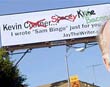
Billboards are appearing in Hollywood saying such things as Kevin Costner, I wrote Sam Bingo just for you.
jaythewriter.com
There are variations. In one, the last name is crossed out and Kline is written in.
I can’t think of any good movie where these two actors could be substituted for each other, can you? But maybe that’s the running gag of the changing billboards.
The author of the billboards and scripts is not a young Hollywood aspirant (Lizzy Weiss before she sold Blue Crush?) or some studio insider with a juicy story to tell, but Jay Taylor, a 67-year old former agency head and copywriter from Tucson, Arizona.
Yes, he has four screenplays in different genres on offer at his www.JaytheWriter.com site.
I wish Mr. Taylor all the best with getting those scripts produced. I hope his screenwriting is as innovative as this in-you-face promotion method. The Arizona Star, a Tucson newspaper says he is “about as subtle as a calliope in a tin shed.”
“Please fax me which ones you want.” is what he says on his website.
Unfortunately, he has publicity in more and more places and most of it is negative. No, it’s slamming: “the sheer audacity of a pathetic individual” “idea that anyone would waste that kind of money doing something so retarded,” that from an anonymous agent in the LA Times, quoted on the www.defamer.com Hollywood insider blog.
What kind of money, you ask? Try $75,000 to $100,000. Even in LA, spending like that on billboard ads pitching your script seems excessive. (Some of the people seeing this billboard must wonder what new sitcom it’s pushing: OK, give me the punchline. Is it “See Ray Romano laugh his way to fame in The Mailroom Fridays, at 8?”)
Still, the marketing stunt got the writer a spot on the Tonight Show recently and the interest of at least one A-list star. Is he named Kevin?
*******
For a gentle view of this marketing campaign, see Creative Screenwriting, current (March/April) issue. More online sightings of this marketing effort are in these blogs.
For the strange paths that some well-known movies like Seven and While You Were Sleeping took to the Googleplex, read The Big Deal.
April 5th, 2005 — Copywriting
With all the internet reading everyone does, sometimes it’s even better to read a book. For advertising, the ultimate one-volume course is the award books.
I say books because I can’t decide whether The Art Director’s Annual or The One Show is the better volume. Joining The One Club offers a range of addditional benefits including their quarterly One as well as various meetings and get-togethers and portfolio reviews sessions.
Both are excellent and will give you the best in advertising the way nothing else can. They include work in every medium, so TV isn’t slighted in these print formats.
Then too, The One Club, at least, offers Annual best commercial reels as well.
It’s fun to browse online commercials for weirdness or occasionally quality, but for plunging into the best advertising work each year, nothing beats these heavy tomes. The Art Director’s Annual current edition weighs five pounds.
If you can read tiny type, you can study more than art direction and concept, you can learn long copy too. These books come out every January.